

Why can't attribution be "solved"?
Because the thing you're trying to measure was never fully trackable in the first place, and it's getting less trackable every year. Attribution isn't broken because your setup is sloppy (though it might be). It's broken by design. Privacy rules, cookie deprecation and consent walls chip away at what you're allowed to see. Dark social, the DM, the Slack forward, the "my mate told me about you", leaves no trace at all. And real buying journeys aren't a tidy line from ad to sale; they're a dozen half-remembered touches over months, most of which no pixel ever caught.
So the honest starting point is this: you will never have perfect attribution. Anyone selling you a tool that promises it is selling you a fairy tale. The trick isn't to "fix" attribution, it's to stop asking it to be something it can't be. Use it as a compass that points you in the right direction, not a courtroom that hands down a verdict on exactly who converted whom.
Marketing influences, sales closes, can we stop the turf war?
Yes, please. Half the reason attribution feels broken is that two teams are fighting over the same trophy. Marketing tries to claim the sale. Sales tries to claim all of it. And round and round they go, both convinced the other lot are stealing credit.
Here's the thing that ends the argument: marketing was never meant to close. That's not its job and never was.
"Marketing was never meant to close sales. Marketing is meant to engage and influence, sales does the closing. So I report attribution of influence, not who claimed the deal."
Once you frame it that way, the turf war dissolves. Marketing's job is to warm, engage and influence the pipeline. Sales' job is to close it. When you report on marketing as an influence on deals rather than a claimant of them, nobody's stealing anyone's credit, you're just showing how the two halves work together. That's the mindset every good report should start from.
How do you actually report attribution to a CFO or founder?
You report influence, and you report what's real. Two principles, and they do all the heavy lifting.
First, report influence, not claimed conversions. There are plenty of tools that stitch your data sources together so you can tell the real story. You can point at a person sitting in your CRM who converted and say: this human also saw one of our ads in the last three months, and a salesperson messaged them on LinkedIn back in the spring. You're not claiming marketing closed the deal. You're showing marketing influenced the deal, which is exactly what it's there to do. Tools like HubSpot, Segment and Clay make that kind of joined-up view possible; the point isn't the tool, it's the honesty of the story it lets you tell.
Second, report what's real, not raw form fills. This is where most reporting quietly lies. Someone says "this ad got 50 conversions" and by "conversions" they mean 50 people hit a contact form. But go into the CRM and look properly: of those 50, maybe 20 were actually qualified, real humans, legitimate messages, a genuine fit for who you're after. The other 30 wanted a job, or wanted to sell you something, or were a bot. They're not conversions as far as the business is concerned.
So I report the 20. And then I attribute the source of the real ones. Not "LinkedIn gave us 30 leads", because it didn't. If 8 of those 20 MQLs came from LinkedIn, then LinkedIn gave us 8 real leads. That's the number I put in front of a CFO or a founder.
"I'm not going to say LinkedIn gave us 30 leads. If 8 of the 20 that actually became MQLs came from LinkedIn, then LinkedIn gave us 8 real leads. That honesty is what I hand a CFO."
It feels like reporting a smaller number, and it is. But it's a number that survives scrutiny, and a CFO can tell the difference between a report that's showing off and a report that's telling the truth. One of those builds trust. The other gets your budget questioned.
What's the surprising insight? You were influencing them months ago.
The most surprising thing attribution can show you comes from tools that track when someone was first influenced, well before the standard 7-day window everyone lives inside.
Most attribution asks a narrow question: what did this person click in the last week? That's useful, but it's the tip of the iceberg. The interesting stuff is further back. These days we build big, data-enriched audiences in Clay, say a 2,000-person list that fits an ideal target profile, and start boosting founder posts and thought-leadership at them, so our name keeps drifting through their feed. Crucially, we record the date each person entered that audience.
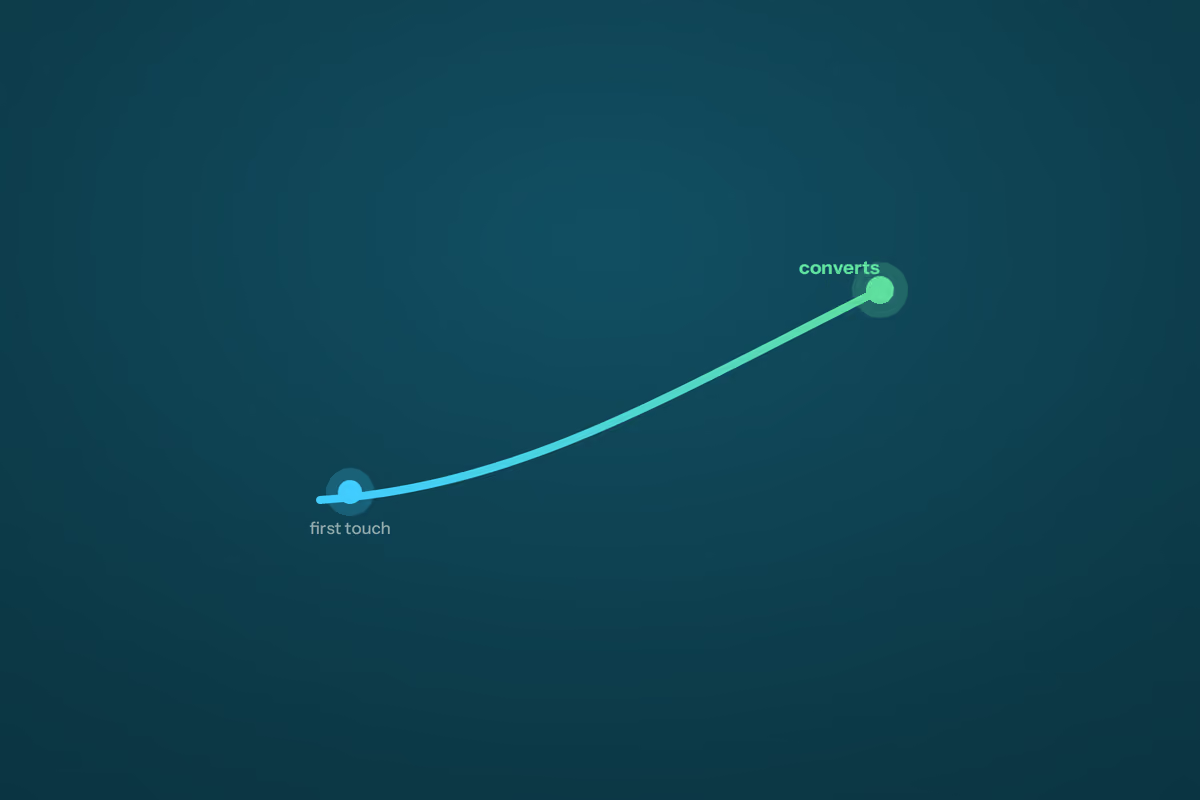
Then, months later, one of them converts. And you can see it plainly: we first tagged and started warming this person six months ago. That's the moment influence stops being a vibe and becomes a timeline.
"Someone always says 'oh, I just Googled you' or 'I saw you at an event.' True, but that's the human version of last-7-days attribution. We'd been warming them for six months. They recognised your sign at the event because they'd been seeing your founder for ages."
This is the bit people miss. Ask anyone "how did you hear about us?" and they'll say they Googled you, or a colleague mentioned you, or they spotted you at an event. All true. But it's the human version of the last-click model, they're reporting the most recent thing, not the first thing. There's almost always an earlier brand or founder influence they've forgotten about. They wandered over to your stand at the event because the sign looked familiar, and it looked familiar because they'd been quietly seeing your founder in their feed for months. Being able to show that full, honest timeline of influence versus conversion is genuinely the coolest thing good attribution can do.
What should you stop obsessing over?
Stop obsessing over pinning a single, tidy source on every deal. It's the wrong goal, and chasing it makes your reporting worse, not better. Here's what to do instead:
- Trade certainty for direction. You don't need to prove exactly who converted whom. You need to know which channels are influencing real pipeline, so you can do more of what's working.
- Qualify before you count. Take conversions to the CRM and count the ones that actually fit. Report MQLs, not form fills.
- Widen the window. The first touch that mattered was probably months before the last click. Track when influence started, not just when it finished.
- Report influence, plainly. Show how marketing warmed and engaged the pipeline that sales then closed. Two teams, one story.
Attribution being broken isn't a problem to solve, it's a reality to work with. Point the compass, tell the truth, and you'll make far better decisions than the person clutching a dashboard that claims perfect certainty. If you'd like senior operators to build reporting that tells the honest story, no junior hand-offs, and you own everything we set up, that's the kind of work we do across analytics and data and GTM engineering. Curious what it'd look like for you? Get a quote.
Frequently asked questions
Is multi-touch attribution dead?
Not dead, just oversold. Multi-touch is still a useful way to see the shape of a journey, but privacy loss and dark social mean it can never be complete or perfectly weighted. Treat it as a directional map, not a precise ledger, and you'll get real value from it.
Should we just ask "how did you hear about us?"
Ask it, but don't trust it on its own. Self-reported answers are the human version of last-click, people name the most recent touch, not the first. Pair the question with tools that show when marketing first started warming that person, and you'll get the fuller, earlier story.
GA4 or a dedicated attribution platform?
Start with Google Analytics 4, it's free, capable and enough for most teams to see channel-level trends. Add a dedicated platform only when you genuinely need to stitch ad, CRM and sales data into one influence view. The tool matters far less than reporting real MQLs honestly.
How do we handle dark social?
You accept you can't fully track it, then triangulate. Watch overall traffic and enquiries trend up as brand activity grows, ask new leads where they first came across you, and use enriched audiences to log when you started influencing someone. You won't capture every DM and forward, but you'll see the pattern.