


Will AI replace your marketing team?
No. It'll change what the job is, not delete the people doing it. AI is a tool, and right now everyone has it. When everyone has the same tool, the tool stops being the advantage. What you do with it becomes the advantage.
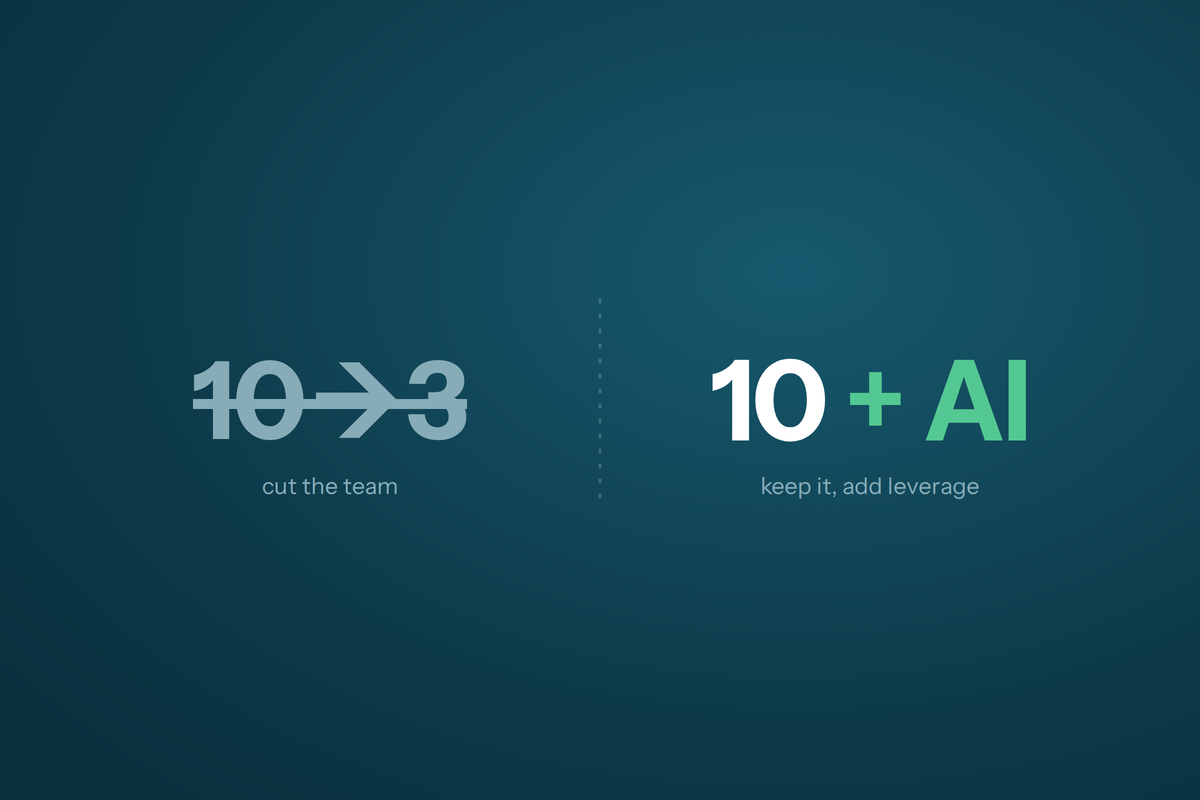
The fear I hear most is some version of "we've got ten marketers, so with AI we'll need three." It sounds efficient on a spreadsheet. It's the wrong maths, and it falls apart the second you look up from your own org chart at the people you're competing with.
Why doesn't the "ten marketers become three" logic work?
Because your competitor kept their ten and gave them AI too. Now they're producing far more than your three ever could, and you've quietly handed them the market. Cutting headcount and backfilling with AI doesn't create some economy of scale. It just caps your output at three people's worth of thinking while everyone else uncaps theirs.
Here's the bit people skip over. AI hasn't shown that it improves marketing on its own. Left to itself it produces the average of the internet, which is exactly the thing you don't want your brand to sound like. What it's brilliant at is taking human strategic thinking and multiplying the output of it. It expands your ideas, drafts the work, points at places worth trying, and does the repeatable middle bit fast. The idea and the judgement still have to come from a person. Fewer people means fewer ideas, and no amount of tooling fixes a shortage of thinking.
You're not being replaced by AI. At worst, you're being replaced by a marketer who uses it better than you do.
So whose job is genuinely at risk?
The pure doers. The roles that are mostly execution with not much judgement attached to them, where the whole job could be written up as a process document. That's the work AI eats first, and it's why juniors and interns feel the most exposed. A lot of early-career marketing is task-running by design: build the thing, format the thing, schedule the thing.
The honest part is that there aren't many pure doers in marketing to begin with, because most marketing decisions carry a judgement call. But it does change how you bring people up. If you hire a junior to be a pair of hands, AI is a cheaper, faster pair of hands. If you hire a junior to learn to think, and hand the hands-work to AI, you've just given them a much better apprenticeship than the one most of us had. The task isn't the value. It never was.
How do you stay valuable when everyone has the same tool?
Stop thinking of AI as the thing that writes your blogs, and start thinking of it as the thing that connects your team. That's the whole shift. The person who says "AI writes my posts now" is optimising a single task. The person who says "AI helps all of us learn faster and build on each other" is changing how the team works, and that's the one who gets more valuable, not less.
It's the same move marketing ops teams have made forever, just further along. We used to systemise the doing: here's how we make a thumbnail, here's how we write a lifecycle email, here's the process so nobody rethinks it from scratch. AI is that operational manual, except now it runs the manual too. Your value moves upstream, to the ideas and the insight the manual can't generate. If you want the fuller version of this, we wrote it up in how we think about AI transformation.
What does the next evolution actually look like?
Marketing brains become company brains. Today most of us use AI as a personal assistant that knows what we told it this morning. The next step is a shared unit of everything the company knows, that every person's AI can read from and write back to.
Picture it properly. Every play you've run and how it did. Your analytics, your content backlog, every post and email and its performance, the product roadmap, the sales calls that landed, the objections that killed deals. You have an idea, you run it past your AI, and it says "someone tried something close to this in Q1, here's what worked and what didn't." You need a customer quote, it pulls a real one from a real call. You want a teammate to see an insight, it writes it into the shared brain so their AI surfaces it when it's relevant. You scope a campaign and it pre-screens the legal risk before a human ever looks.
The value was never the average of the internet. It's the context only your company has, and only your team can build.
That's the thing AI can't replace, because it's the thing you feed it. We started Wayward partly because this shift is coming whether teams are ready or not, and most aren't (a bit of that story is in why we started the company). The teams that win won't be the ones who cut heads to save money. They'll be the ones who kept their people, gave them AI, and built the shared brain everyone else is still arguing about.
If you're weighing up what to keep human and what to hand over, book a free Growth Audit and we'll map it against your actual team, with no lock-in and you own everything we build.
Frequently asked questions
Is it a mistake to cut marketing headcount because of AI?
Usually, yes. Cutting from ten to three doesn't give you an economy of scale, it caps your output at three people's ideas while any competitor who kept their ten and added AI out-produces you. AI multiplies human thinking, so fewer thinkers means less to multiply. Keep the people, raise their output.
Which marketing roles are most at risk from AI?
Pure doers: roles that are mostly execution with little judgement attached, which is why task-running juniors and interns feel it first. The fix isn't to stop hiring juniors, it's to hire them to learn to think and let AI take the hands-work, which is a better apprenticeship than most of us got.
How do I make myself more valuable as a marketer in the AI shift?
Stop treating AI as the thing that does your individual tasks and start treating it as the thing that connects the whole team. The marketer who helps everyone learn and build on each other's work gets more valuable. The one who just automates their own blog gets easier to replace.
What is a company brain and why does it matter?
It's a shared store of everything the company knows: plays and their results, analytics, content and its performance, product, sales calls that worked. Each person's AI reads from it and writes back to it, so ideas get checked against what's already been tried and insights spread automatically. It's the context only your company has, and it's the part AI can't replace because you're the one who builds it.
